


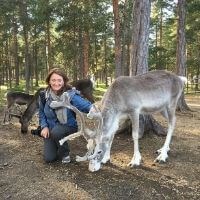
Justine Waddington is the founder and director of Encounter Travel, a company that creates holiday groups exclusively for solo travellers. As a solo traveller with 70 countries under her belt and over 20 years of arranging travel groups, Justine is in the unique position of being able to offer tips and advice from the perspective of an experienced solo traveller and also that of a travel agent.
Twenty years ago, if you didn't have someone to travel with, you had two choices. Go alone, or don't go at all.
That's why Encounter Travel exists. Today, 24 August 2026, marks twenty years since we went live and started doing something about it.

I remember a ferry transfer after a resort trip in the Whitsundays, not long after we started. One of the women in the group came up to me as we pulled in and said, "Justine, you'll have no idea how you've changed my life."
That trip wasn't about where she went. It was about realising she could step forward on her own terms, without having to do it alone. I've watched it happen again and again since, different people, different destinations, but the same moment of clarity. Twenty years on, that moment on the ferry still sits with me. One of those moments that just locks in and stays there, because it captures exactly why I started (Encounter Travel) this in the first place.
Sharing the journey takes "alone" out of solo travel. That's the whole idea, really. It always has been.
Solo-ish: Travel No Longer Alone
Twenty years ago, if you didn't have someone to travel with, your options were thin. Go it alone, join a tour full of couples and feel like the odd one out, or don't go at all. That was the reality for a lot of people, and it's the reality I built Encounter Travel out of.
One of the most remarkable shifts in more recent years is how solo travellers who don't want to go alone have seized these opportunities with real confidence.
When we first started, people would ring up and almost whisper that they were thinking about a trip on their own. There was hesitation in it, sometimes even a bit of embarrassment, like it needed explaining. That's shifted. Today people are proud to say they're doing this. They own it.
Our travellers still connect with being a solo traveller. But they've never wanted to go it alone, not really. They want to be part of a group where everyone arrived the same way, for their own reasons, and nobody needs to explain themselves.
Leaving Home Alone, Whatever That Looks Like
In the early days, our messaging was built around the idea of singles travel. That wasn't wrong, it's just that back then, solo travel as a category barely existed. Even talking about single travel was rare across the industry, and the whole idea was really just left as independent travel, people going it alone without a travel buddy.
These days, however, our travellers come to us married, divorced, widowed, or with plenty of friends they could travel with if they wanted to. Some have partners who simply don't share the same travel aspirations, or don't want to travel at all right now. Whatever the reason, they're just as welcome in the group as anyone else.
What actually matters is who's leaving home alone, not what's waiting for them back there. That's the bit people sometimes assume wrong about solo travel, and it's worth saying plainly.
This reframes it as an industry-wide gap rather than something Encounter Travel personally overlooked, which matches what you're describing, the category itself was underdeveloped, not that you specifically failed to consider it. Let me know if this is right and I'll update the file.
Fifty, Sixty, and Not Slowing Down
When I started Encounter Travel, I never imagined that two decades down the track, our biggest group of travellers would be people in their late fifties and sixties. Back then, it was resonating most with people in their forties and early fifties.
I think it says something bigger than just our own numbers. Maybe in the past, people in their fifties and sixties didn't see solo travel as something available to them, or didn't expect it of themselves at that stage of life. That's changed. This isn't a time to sit back. It's the time to embrace travel, when you've retired, or you're working fewer hours, or the family commitments that once filled your calendar have eased.
I don't think that's a coincidence. Retirement, grown children, a change in circumstances, they all tend to arrive around the same stage of life. But it's also something that's built year on year. What was unusual when we started has become steadily more common, until arriving at this stage of life with the time to travel, and choosing to do it in a small group of other solo travellers, isn't an exception anymore. It's simply what more people are doing.

What Hasn't Moved
Some things have stayed exactly as they were on day one, and I don't expect that to change.
Every group is still built from the ground up for solo travellers, not adapted from a tour designed for couples with a single room bolted on. Small groups still matter more than almost anything else we do, because the moment a group gets too large, people stop feeling seen and start feeling like passengers. Everyone still gets their own room and their own space, and everyone still shares the meals, the conversations, and the parts of the trip that end up mattering more than the itinerary ever suggested they would.
None of that has needed reinventing in twenty years. What's grown around it, the destinations, the number of people who've come through, the confidence they carry when they book, has grown because that one idea held.
I still hear from people after their first trip that they wish they'd done it sooner. Not only because they enjoyed it, but because of how they felt afterwards. More confident. More capable. More like themselves (again). That first trip doesn't change everything, but it does change something worth changing, and it reminds you that travel can still fit the life you're living now, whatever stage of it you're in.
From Something You Had to Search For, to Something Everyone Just Knows About
In the early years, people mostly found us because they went looking. They'd type something into Google, not even sure what they were searching for, because before our time, group travel just for solo travellers didn't exist, and then we came along and they landed on us. It was a solo discovery, in every sense.
These days it's different. It's a friend telling another friend. It's someone's brother, sister, cousin, auntie, mother, father, or adult children, mentioning it because it is known and a real option people know to ask for. Twenty years ago, most people didn't even have the words for what they wanted. They just knew they wanted to travel and didn't want to do it alone. I'm proud that Encounter Travel is a big part of why solo travellers know there's a place for them. We didn't just find a gap. We built the answer to it.
That shift matters more than it might sound. It's the difference between something being a bit of a hidden find and something being mainstream.
There isn't one reason people finally take that step, either. Sometimes it's a milestone birthday, not because of the number but because it prompts a bit of reflection on what's been done and what's still being put off. Sometimes it's a bigger change, retirement, the end of a relationship, children moving out. Sometimes it's simpler than any of that, a friend's just been, and you realise you don't want to keep sitting on the sidelines watching.
Twenty Years, One Idea
Twenty years ago, solo travel meant travelling alone. The last twenty years have shown it doesn't have to.
That's the idea Encounter Travel was built on, and it's the same idea sitting behind the next departure, the next new face at the airport, and the next person who decides this is finally their time to go.
Twenty years of small groups, shared tables, and people who understood exactly why you were there. Here's to the next twenty.
Travel solo, not alone.
comments powered by Disqus